
Faith Enough
As we wrap up our Back to Basics series, I am left with a lingering question: what is the purpose of faith? The author of Hebrews tells us that “faith is the assurance of things hoped for, the conviction of things unseen.” Which is a useful definition as we have demonstrated together over the last few weeks. However, it still leaves me wondering about the purpose behind this. Why should we have faith? What does it do?
The first week of this series, we talked about how faith is born in God. That it is God’s movement toward us, or within us, that first brings about this assurance. That Wesleyan concept of Prevenient Grace serves us so well here as we can see that it is grace moving within us that first inspires us to faith. Grace draws us toward God, pulling us deeper before we are ever even aware of the luring work of the Spirit. If this is true, then maybe the purpose of faith is simply to bring us closer to God, deeper into the center of who we are as God’s children.
However, as the series has unfolded, we have seen that faith is a two-way street. It might begin with God, but it continues with our response to grace. Like Abraham, we can choose to respond by moving toward faith, stepping into the unknown, or moving away from it. We are free, after all, and our freedom is real and meaningful. God does not force us to draw closer, grace is not irresistible, we are not predestined for anything. Our choices matter. So, then, perhaps faith is a way of aligning our responses such that we are more likely to respond positively to grace than negatively, continuing to deepen our relationship with our Creator.
Yet, the last two weeks, we’ve examined how faith is more than just about our relationship to God. It impacts our relationships with others, and with the world around us. We are called to a faith that acts for the well-being of others, like Shiphrah and Puah, the midwives who saved Moses, and other Hebrew babies, despite Pharaoh’s genocidal orders. We are called to a faith that is just, as the prophet Amos reminds us that our faith, our worship, must be about more than just alignment. In the same spirit (a Holy one?) James says our faith must have works, or else it is dead. Perhaps, then, faith is about acting rightly so that the world would be more like the Kingdom of God.
Truthfully, I think faith is about all of these things. Faith is our free response to the work of grace stirring up assurance within us. It is a response that is best found in works of justice and love which promote the well being of all Creation. Faith is an assurance of things hoped for, a commitment that we will work toward those hopes, seeking to build the Kingdom of God here on earth as it is in heaven. Faith is a conviction that we are called to the work of God, not in order to earn a place into a post-death paradise, but in order that our world would be a better place while we are here.
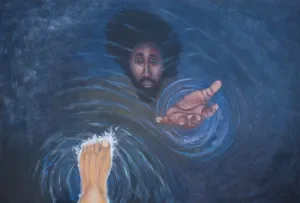
The greatest thing about faith, I have come to find, is that a little goes a long way. The smallest light can illuminate the darkest places, the smallest bit of hope can carry us through the hardest times. That will be the topic of our sermon this week as we read the story of Jesus walking on water and Peter trying his best to mimic that. I won’t spoil the whole sermon for you, but I will say that Peter’s faith is more than enough, not because he is able to walk on water, but because he knows who to reach out to when he starts to sink.
See you Sunday, friends.
Grace and Peace,
Rev. Tim
P.S. We will be combined for worship at 10:45 and have a potluck afterward!
