
God is Love: A Theological Reason to Move House
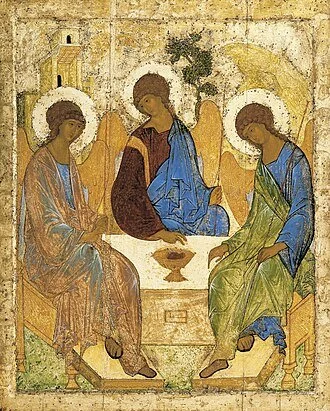
Trinity icon by Andrei Rublev. Found on Wikipedia - https://en.wikipedia.org/wiki/Trinity_%28Andrei_Rublev%29
As you are reading this, my wife and I are somewhere in the process of closing on and moving into our first house. It is an exciting, albeit stressful, time for us. We are moving, in case you aren’t aware, so that we can be closer to Lake Cities UMC. We have ended up about as close as we could possibly get – walking distance right around the corner! We made a decision a couple years ago that, when I was appointed somewhere as Senior Pastor, we would move to live in the same community as the church. That decision was made, in part, because of the theology I hold. Let me explain.
That theology can be summed up in the words of our scripture for this Sunday, 1 John 4:7-12. Verses 7 and 8 read, “Beloved, let us love one another, because love is from God; everyone who loves is born of God and knows God. Whoever does not love does not know God, for God is love.” The emphasis is mine, and highlights the key part of this scripture text: God is love. Those three words form the core of my theology, and the core of what the Bible is all about. From the opening poem of Creation, to the story of Adam and Eve, to the rise and fall of the Kingdom of Israel, through the words of the prophets and wisdom teachers, across the centuries to the stories of Jesus and the letters of the early church, the Bible speaks with countless voices all pointing in the direction of this simple phrase: God is love.
It is a deceptively simple phrase that can carry with it countless complexities. Since this isn’t a space for lengthy theological musings, I’ll keep it short. When we say that God is love, we do not simply mean that God loves very much or that God loves everyone or that love is very important to God. We mean that it is God’s nature to love. God loves in the same way that we breathe – reflexively, naturally, and constantly. Love, of course, is not a thing that can be done alone. Love requires at least two parties, the lover and the beloved. In short, love is always relational. So, if it is God’s nature to love, then God is relational. God is in relation with all the world – you, me, those annoying drivers that dart into an exit lane at the last moment, trees, birds, worms, all creation.
Of course, you and I both know that humans are relational creatures. We aren’t made to be alone. We are made to be connected to one another, and to the rest of Creation. This is God’s image in us, the relationality of God reflected in our being drawn together. When we live into that relationality, by loving our neighbors, our enemies, and whomever else we meet, we reflect Christ into the world. In a way, we become little incarnations of God, representations of the Divine Lover pouring out love onto the Beloved. When the letter writer says, “Beloved, let us love one another, because love is from God…God is love,” they are pointing to this reality. They are gesturing toward the reality that we are made in the image of a loving God and that, by loving, we enhance that image in the world.
I know what you’re thinking. “Rev. Tim, what does any of this have to do with you and Katie moving to Lake Dallas??” I’m so glad you asked. See, in Jesus, God’s relationality is made fully apparent. When the Word becomes flesh, and God lives amongst Creation, the fullness of love is seen and witnessed. The fullest expression of love is to, as the Message version of the Bible puts it in the paraphrase of John 1:14, “move into the neighborhood.” So, we’re moving into the neighborhood. Not because I wanted a shorter commute, not because it’s helpful to be close to the church, and not because we just really wanted to move. We’re moving because it is just one way we can lean in to love and reflect the image of God into the world.
See you Sunday, friends. It’ll be my shortest commute to worship ever!
Rev. Tim
