
History, Stained Glass, and Parables
What a joy it was to be in worship with this church last Sunday! I felt the Spirit moving, even amidst some of my own miscues, and I felt the Spirit especially in the warm welcome my family and I have received among you. I look forward to continuing to learn your names, hear your stories, and settle into the work of God here at Lake Cities UMC.
Last week, as I unpacked books and set out plants, I found myself digging through the Pastor Files left over the years in this office. Buried in one of the desk drawers was a packet of paper compiled some years ago which tells, in various voices, the history of Lake Cities UMC. As I read through these stories, I was struck by the way this church has been consistently dedicated to serving its community through ups, downs, and all the in-betweens. It is clear to me that LCUMC has never been a church that was just in it for itself, but has a history of loving and serving the Lake Cities area through all its iterations. As a new pastor, I cannot tell you what a joy it is to join a church that has such a rich history of service.
This week in worship, we’ll be looking at a parable which is found in Matthew, Mark, and Luke. For our purposes, we’ll stick to the version Matthew tells in Matthew 13. The parable is variously called “The Parable of the Sower,” and “The Parable of the Four Soils.” You may have heard it before, but the short version is: A sower went out and threw seeds everywhere, some landed on hard ground, some in shallow soil, some among weeds, and some in good, fertile ground. Those seeds that landed in the good ground grew exceptionally well, while the others failed in one way or another. The author of the Gospel of Matthew then goes on to offer an explanation of this parable, naming the seeds as the gospel message and the soils as various kinds of recipients of that message.
Parables are wonderful tools for teaching, learning, and growing because they can be looked at from all kinds of angles. In fact, the root words for “parable” refer to something that can be seen from multiple sides. This week, as I think about this story, I cannot help but see it from the perspective of the soil. That perspective leads me to a question: what kind of soil are we? Are we hard-packed ground? Are we thorny? Are we shallow? Or, are we good ground, ready to receive the Gospel call to love? What if we aren’t called to be ground at all, but are actually meant to be sowers?
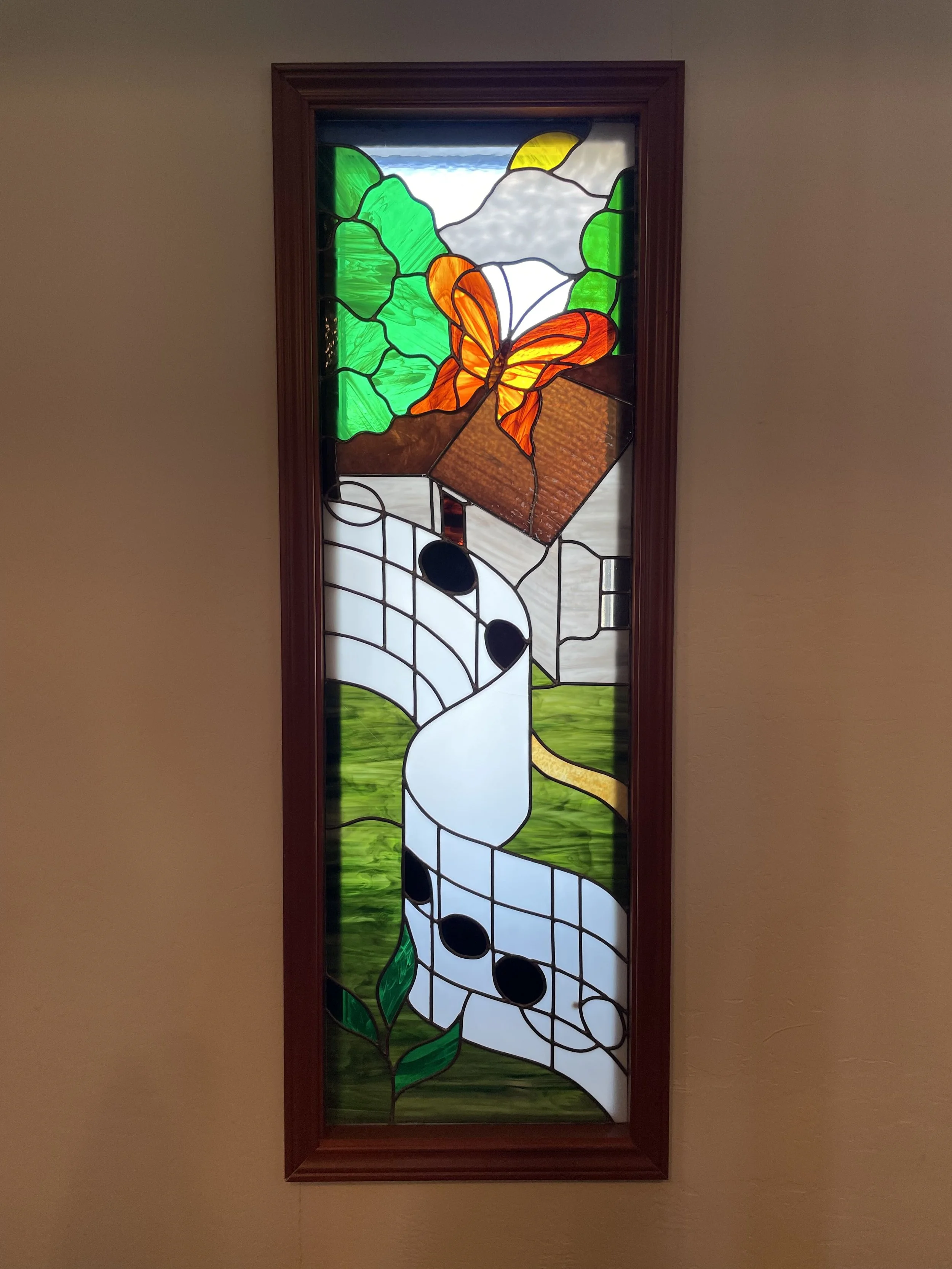
One of the other history items I found in this desk is a little book titled Our Heritage Windows that details the stained glass windows in the Sanctuary. I took it and looked at each window while reading through the artist’s thoughts and intentions behind the imagery. Paired with our parable, I am struck by the “Heritage” window (pictured above) and this line from its description: “Like the young seedling the church was born small, yet like the mighty oak it has now grown and matured.” When trees grow up, they start sowing new seeds to grow new trees. When the roots go deep, the blooms appear, and new seeds are sown. Whatever ground LCUMC has been, deep roots have grown. Now, as we look to the future together, my prayer is that, like the oak tree, we can become sowers who bloom brightly with the seeds of God’s love.
See you Sunday, friends.
Grace, Peace, and Love,
Rev. Tim
